
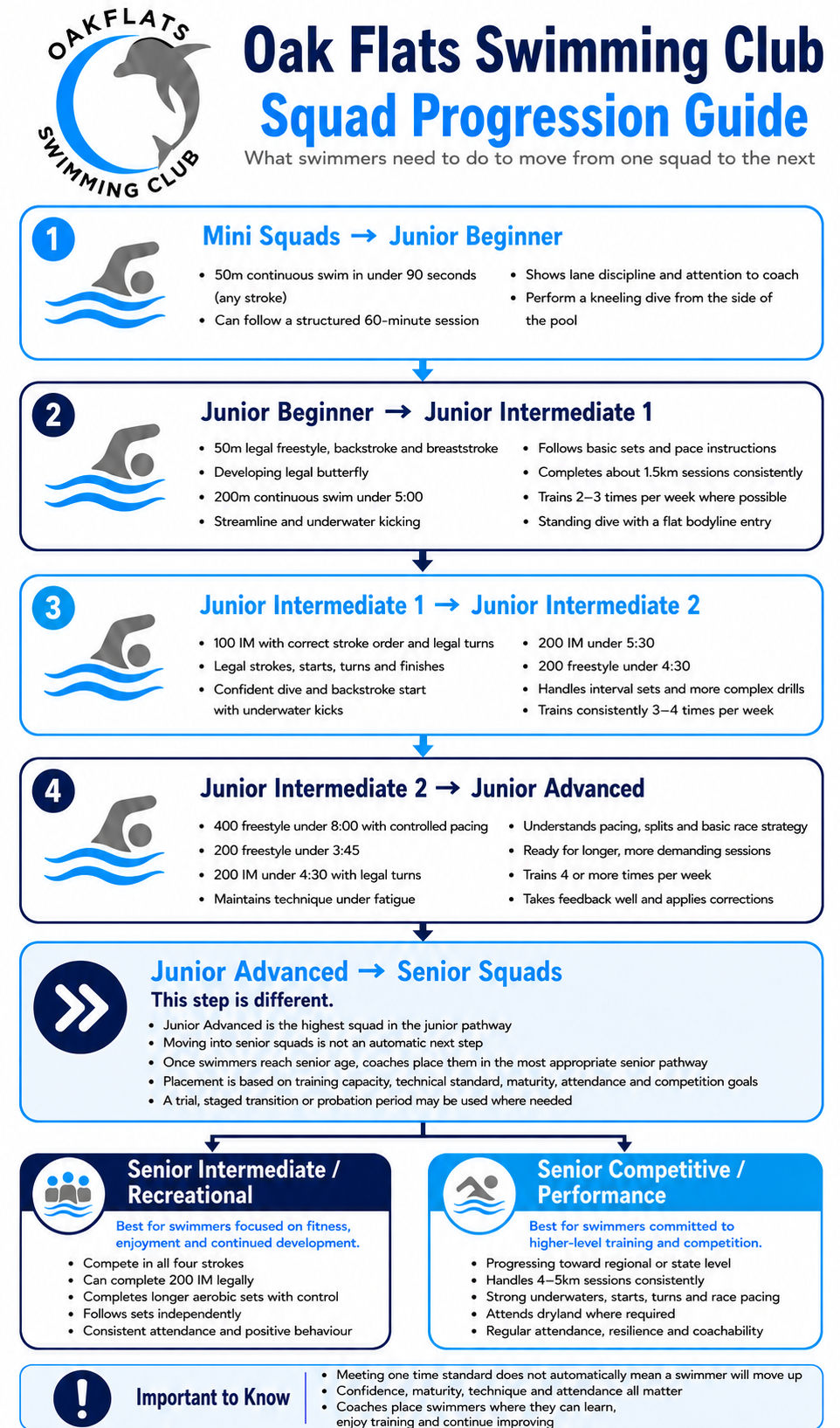
Following feedback from both parents and our coaching team, we have made some changes to the way testing will be conducted. The aim is to make the process clearer, less disruptive to training and more closely aligned with the long-term development needs of our swimmers.
Testing will now occur every second month
Rather than testing every month, formal squad testing will take place during the final week of every second month.
Our planned testing months are:
- July
- September
- November
- January
- March
The first testing window will occur in the final week of July.
Testing will not take place in every session during these weeks. Lead coaches will advise families via WhatsApp the week before testing and will confirm which sessions will include formal testing.
This change has been made deliberately. Feedback from parents and coaches indicated that monthly testing could be disruptive to normal training and did not always allow enough time for swimmers to meaningfully develop between testing periods.
Moving to a bi-monthly testing model allows:
- more consistent training blocks between formal assessments;
- more time for swimmers to develop skills and confidence;
- coaches to assess progress over a longer period;
- less pressure on swimmers to produce a result every month; and
- greater emphasis on long-term development rather than short-term outcomes.
This is consistent with the broader principles of long-term athlete development, where progression should be based on building the right skills, habits and physical capacities at the right stage of development.
What will testing involve?
Formal testing sessions will include timed swims linked to the progression benchmarks for each squad.
However, this is very important:
- Passing a timed test does not automatically result in a squad move.
- Timed swims are only one part of the progression process.
In many cases, competency in the required skills is more important than the time itself. Coaches will also consider:
- stroke technique;
- starts, turns, finishes and underwater skills;
- ability to follow sets and pace instructions;
- skill retention under fatigue;
- behaviour and lane discipline;
- attendance and training consistency;
- attitude and coachability;
- confidence and emotional readiness; and
- readiness for the training demands of the next squad.
Many of these areas are assessed informally through regular training sessions, not just on the day of a formal test.
Coaches are looking at the full picture of each swimmer over time.
Squad Progression Benchmarks
The attached Squad Progression Guide provides a visual summary of the progression pathway. The key benchmarks are outlined below.
Mini Squads → Junior Beginner
Swimmers are generally ready when they can:
- complete a 50m continuous swim in under 90 seconds in any stroke;
- follow a structured 60-minute session;
- show lane discipline and attention to the coach; and
- perform a kneeling dive from the side of the pool.
Junior Beginner → Junior Intermediate 1
Swimmers are generally ready when they can:
- swim 50m legal freestyle, backstroke and breaststroke;
- demonstrate developing legal butterfly;
- complete a 200m continuous swim in under 5:00;
- demonstrate streamline and underwater kicking;
- follow basic sets and pace instructions;
- complete approximately 1.5km sessions consistently;
- train 2–3 times per week where possible; and
- perform a standing dive with a flat bodyline entry.
Junior Intermediate 1 → Junior Intermediate 2
Swimmers are generally ready when they can:
- complete a 100 IM with the correct stroke order and legal turns;
- demonstrate legal strokes, starts, turns and finishes;
- complete a confident dive and backstroke start with underwater kicks;
- swim 200 IM under 5:30;
- swim 200 freestyle under 4:30;
- handle interval sets and more complex drills; and
- train consistently 3–4 times per week.
Junior Intermediate 2 → Junior Advanced
Swimmers are generally ready when they can:
- swim 400 freestyle under 8:00 with controlled pacing;
- swim 200 freestyle under 3:45;
- swim 200 IM under 4:30 with legal turns;
- maintain technique under fatigue;
- understand pacing, splits and basic race strategy;
- manage longer and more demanding sessions;
- train 4 or more times per week; and
- take feedback well and apply corrections.
Junior Advanced → Senior Squads
This transition is different from the earlier stages of the pathway.
Junior Advanced is the highest squad in our junior pathway.
We want to be very clear about the rationale behind this.
The junior years are a critical period for skill acquisition. Our priority is to develop strong stroke technique, starts, turns, underwaters, pacing awareness, race skills and training habits before swimmers move into more senior training environments.
Senior squads place greater emphasis on higher training loads, energy-system development, physical preparation and competition-specific demands.
For that reason, moving from Junior Advanced into a senior squad is not an automatic next step.
Once swimmers reach senior age, coaches will consider the most appropriate pathway based on:
- training capacity;
- technical standard;
- maturity;
- attendance;
- competition goals;
- readiness for higher training loads; and
- ability to train independently and responsibly.
This may mean movement into a Senior Intermediate / Recreational pathway or a Senior Competitive / Performance pathway.
Where appropriate, a staged transition, trial or probation period may be used.
This is not about holding swimmers back. It is about making sure they move into the right environment at the right time.
Moving up earlier does not automatically lead to better results.
In some cases, spending longer consolidating skills, confidence and training habits in the current squad will lead to better long-term outcomes than progressing too quickly.
Our coaches will always aim to make decisions in the best interests of the athlete.
How progression decisions will be communicated
Following a testing period, coaches will discuss progression decisions directly with the swimmer and parent on pool deck.
Parents are also welcome to request their child’s testing data if they would like to review it.
Timed results will be recorded by coaches, but progression decisions will also draw on:
- regular training observations;
- skill development across normal sessions;
- behaviour and attitude;
- attendance and consistency; and
- the coaching team’s overall assessment of readiness.
While most squad progression decisions will generally be tied to the bi-monthly testing periods, progression may occasionally occur outside those windows where a swimmer is clearly ready or where an individual transition is considered to be in the swimmer’s best interests.
Questions about your child’s progression
We understand that squad progression is important to swimmers and families, and we are always happy to discuss it.
Parents are welcome to:
- speak with their coach on pool deck before or after training;
- email the relevant lead coach; or
- contact the coaching team at coach@oakflatsswimmingclub.com.au.
Coaches will also make themselves available for a separate discussion upon request where more time is needed.
Our aim is to make this process as clear and transparent as possible while keeping the focus where it belongs: on the long-term development, confidence, enjoyment and success of each swimmer.
Thank you for your continued support of our swimmers and coaching team.
Squads Information
WINTER SCHEDULE JUNE – SEPTEMBER
| SQUAD | SQUAD | SQUAD | |
| SENIOR / JNR ADV (50m) | JUNIOR (50m) | MINI SQUADS (25m) | |
| 6:00-7:30am | 7:00am-8:00am | 7:00am-8:00am | |
| 5:00-6:30pm | 4:00-5:00pm | 4:00-5:00pm (Friday only) |
SUMMER SCHEDULE OCTOBER – MARCH
Mornings Monday to Friday for All Squads | Afternoons Monday to Thursday for Seniors & Juniors
Mini Squads of an Afternoon will be Friday only in the 25m pool
| SQUAD | SQUAD | SQUAD | |
| SENIOR / JNR ADV (50m) | JUNIOR SQUADS (50m) | MINI SQUADS (25m) | |
| 6:00-7:30am | 7:00am-8:00am | 7:00am-7:55am | |
| 5:00-6:30pm | 4:00pm-5:00pm | 4:00pm-5:00pm (Friday Only) |